The Mitigation panel consolidates the operational effectiveness of countermeasures applied to assessed scenarios. This environment allows security directors to audit the performance of their safeguards and mathematically verify whether investments in physical, technological, and process protection are reducing threats to tolerable levels for the organization.

At the top of the dashboard, the two metric states of the exercise are immediately contrasted:
-
Inherent Level (Initial): The base risk state of the site before considering any protective measure.
-
Residual Level (Mitigated): The actual remaining risk level once the system processes the weight and validity of assigned controls (for example, managing to lower overall criticality from Unacceptable to Tolerable).

Mitigation Dashboard Components
The analytical quadrant processes defense effectiveness through the following visual indicators:
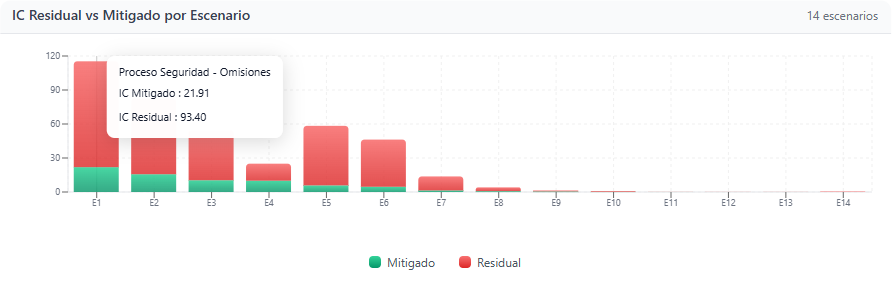
1. Residual CI vs Mitigated by Scenario
Comparative bar chart that breaks down scenario by scenario the impact of countermeasures. The bar visually shows the original risk (Residual/Inherent) versus the fraction that has been effectively neutralized (Mitigated), allowing tracking of which specific events still require greater robustness in their protections.
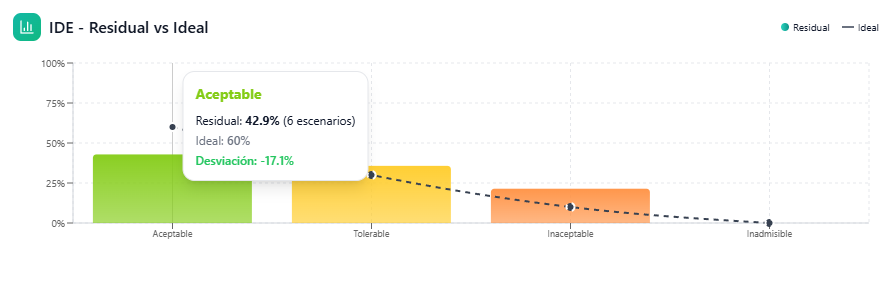
2. SDE – Residual vs Ideal
This module measures the regulatory success of the treatment plan. It shows how many scenarios have been pushed toward acceptability ranges (Acceptable and Tolerable) and how many remain in critical zones, contrasting the current reality against the optimal performance expected by the corporation.
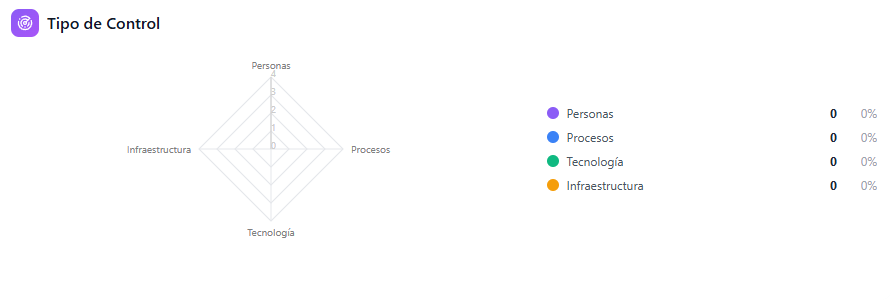
3. Control Type and Strategy
Two key tools for security resource auditing:
-
Radar Chart (Control Type): Classifies the balance of defenses by distributing them across four fundamental protection axes: People, Processes, Technology, and Infrastructure.
-
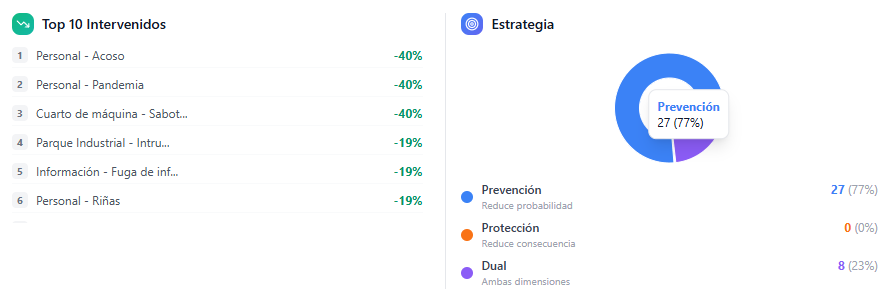
Strategy Chart (Donut): Segments the nature of applied actions, detailing the exact percentage of controls focused on Prevention (reducing the probability of occurrence), Protection (reducing the impact or consequence), or of a Dual nature (covering both dimensions simultaneously).
4. Top 10 Addressed
A dynamic control listing that prioritizes the scenarios that have received the greatest security optimizations, reflecting the exact percentage of risk reduction achieved in each of them.